Introduction
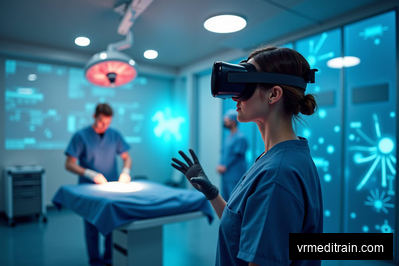
The medical field has always been at the forefront of adopting new technology, aiming to improve patient care and outcomes. One such innovation that has seen a dramatic rise in application within healthcare is Virtual Reality (VR). From its early inception in the late 1980s to the sophisticated systems of today, VR has evolved to become an integral part of medical training.
This blog post explores the evolution of Virtual Reality in medical training, examining how it’s been used, its benefits, challenges, and the future of VR in the medical landscape.
In the realm of healthcare, the significance of a compelling introduction cannot be overstated. An engaging introduction sets the tone for the entire piece, drawing readers in and piquing their interest from the outset. For instance, in a blog post discussing the latest advancements in telemedicine, a well-crafted introduction could highlight the transformative impact of virtual consultations on patient accessibility and convenience. By succinctly outlining the key benefits and potential implications of this technology, the introduction serves as a gateway to deeper exploration, captivating readers and motivating them to delve into the intricacies of the topic.
Early Applications and Developments
The use of VR in medical training initially focused on improving manual dexterity and procedural knowledge. Early applications include the 'Virtual Reality Surgical Simulation' developed by Dr. Richard Satava in 1989. This simulator replicated simple surgical tasks, marking a significant step in utilizing VR for medical training.
The late 1990s and early 2000s saw VR being used to simulate more complex procedures, with systems like the 'Lap Sim' offering a safe environment for surgeons to practice laparoscopic surgery. The 'Da Vinci Surgical System,' while not a pure VR system, leveraged VR principles to enhance the precision of robotic surgery.
In the realm of early applications and developments, the integration of virtual reality technology in military training programs has shown promising results. Combat simulations leveraging VR have allowed soldiers to engage in realistic scenarios, enhancing decision-making skills and strategic thinking. Furthermore, the aviation industry has embraced VR for pilot training, offering immersive experiences that replicate cockpit environments and emergency situations. These advancements underscore the versatility of VR beyond traditional boundaries, paving the way for innovative uses in diverse fields.
Modern VR Applications in Medical Training
VR has now advanced to offer highly detailed and realistic simulations. It provides immersive, multi-sensory experiences that mimic real-life scenarios, making it a highly effective tool for training. For example, 'MPathic-VR,' a platform developed by Medical Cyberworlds, uses VR to improve communication skills among medical professionals.
Companies like 'Fundamental VR' have combined VR with haptic feedback to create a 'flight simulator for surgeons,' allowing them to feel the texture and resistance of virtual tissues. Similarly, 'Osso VR' provides orthopedic surgeons with a realistic operative experience.
In the realm of medical training, modern VR applications have revolutionized how aspiring healthcare professionals learn and practice crucial skills. These applications now offer intricate surgical simulations that replicate real-world scenarios with astonishing accuracy. For instance, trainees can perform virtual surgeries using haptic feedback technology, allowing them to experience the tactile sensations of surgery in a safe, controlled environment. This level of immersion and realism not only enhances learning outcomes but also boosts confidence and proficiency in handling complex medical procedures.
Benefits and Challenges
The use of VR in medical training offers numerous benefits. It provides a risk-free environment for practice, enhances visual-spatial awareness, improves hand-eye coordination, and can even reduce the time and cost associated with traditional training methods. For instance, a study published in the 'Journal of Surgical Education' found that VR-trained surgeons completed procedures 29% faster and made six times fewer errors than those trained traditionally.
However, like any technology, VR also has its challenges. These include the high cost of VR equipment, the need for regular software updates, and the potential for users to experience 'cybersickness.' Moreover, the effectiveness of VR training depends heavily on the quality of the simulation, requiring a significant investment in software development.
While the benefits of VR in medical training are undeniable, challenges such as high initial costs and technical complexities need to be addressed. Implementing VR technology requires substantial investment in equipment and software, which can be a barrier for smaller healthcare institutions. Additionally, ensuring seamless integration of VR simulations with existing training curricula and platforms can pose compatibility issues and require dedicated technical support. Overcoming these challenges is essential to fully capitalize on the benefits of VR, such as improved knowledge retention and enhanced procedural skills development in a safe and controlled environment.
The Future of VR in Medical Training
As technology continues to evolve, so too will the application of VR in medical training. The future may see VR systems incorporating artificial intelligence to offer personalized training modules. Advances in haptic technology could also improve the realism of VR simulations, enhancing their effectiveness as training tools.
Moreover, with the advent of 5G technology, it's possible that we could see the rise of remote VR training, where experts guide trainees through procedures in real-time. This could revolutionize medical training, making it more accessible and versatile.
Advancements in VR technology are poised to revolutionize medical training methodologies, offering immersive simulations that mimic real-life scenarios with unprecedented realism. Imagine medical students being able to practice intricate surgical procedures repeatedly in a risk-free virtual environment, refining their skills under various challenging conditions. Additionally, VR can be tailored to provide personalized learning experiences, catering to the individual needs and pace of each student. This personalized approach not only enhances retention but also fosters a deeper understanding of complex medical concepts, ultimately leading to more competent healthcare professionals.
Conclusion
The evolution of Virtual Reality in medical training is a testament to how technology can enhance education and skills development. From early surgical simulators to today’s immersive multi-sensory experiences, VR has established its place in the medical training sphere. While challenges exist, the potential benefits for patient outcomes and healthcare efficiency are undeniable.
As we look to the future, continued advancements in VR technology promise exciting possibilities for medical training. Ultimately, the goal remains the same: to use technology to improve healthcare, making it safer, more efficient, and more effective.
In conclusion, the transformative impact of Virtual Reality on medical training underscores the evolving landscape of educational technology. As medical professionals increasingly turn to immersive simulations for hands-on experience, the efficiency and effectiveness of training programs have reached new heights. For instance, advanced VR modules now allow medical students to practice intricate surgical procedures in a virtual operating room, providing a safe yet realistic environment for skill development. This integration of VR technology not only enhances learning outcomes but also revolutionizes the traditional approach to medical education.